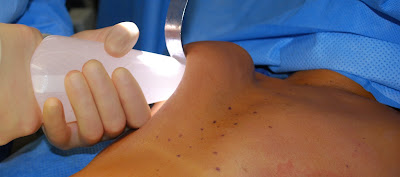
Capsular contracture surgery involves removing the breast capsule that has formed over many years and then place a new breast implant of similar or different dimensions or size. Typically recovery from capsular contracture surgery can be quicker than the recovery from the original breast augmentation procedure. The goal of capsular contracture surgery is to remove the painful capsular contracture and allow the breast to re-drape or re-expand over the new breast implant.
The Brian P. Dickinson, M.D. Revsision Aesthetic Breast Surgery Blog is an online professional journal with reflections, comments, experiences, opinions, articles, and patient testimonials related to Revsision Aesthetic Breast Surgery.
Showing posts with label Capsular Contracture Surgery. Show all posts
Friday, October 28, 2011
Sunday, October 2, 2011
Synmastia Correction & Capsular ContractureSurgery
Synmastia occurs when a breast implant begins to cross the midline towards the sternum. This is often upsetting to the patient and is often even more accentuated when wearing a bra or low cut shirt. Correction of synmastia can be challenging for both the patient and surgeon.
Appropriate steps in synmastia correction require accurate diagnosis of the problem. Synmastia can occur from either an overly large pocket medially above or below the pectoralis muscle. Quite commonly this can be more obvious by an implant with too large a base diameter for the rib cage or thorax. It is also common for the patient to have a capsular contracture at the same time.
Patients often ask me what they will look like post-operatively from capsular contracure surgery in terms of bruising. I often tell patents that swelling is normal and can be expected for quite some time following capsular contracture and synmastia surgery. The photo above shows and early (5 day) post-operativel result. I tell patients that early post-operatively the implants and breasts take on a globular shape which improves in almost regular intervals at one month, two months, four months, six months, and then finally at one-year.
Capsular contracture surgery is commonly performed either because the capsules are causing a significant amount of pain to the patient or the capsules are starting to distort the breast shape or size.
Typically capsular contracture surgery tends to restore a normal contour to the breast. Patients often ask me what they will look like after surgery in terms of bruising or swelling.
I often tell patients that during capsular contracture surgery, they may require drains post-operatively to removed fluid from the breast pockets. The drains typically exit just lateral to the breast. Drains can be left in place from one to 5 days post-operatively. The patient in the photo above is an early (5 days) post-operative result.
www.drbriandickinson.com
Tuesday, November 16, 2010
Strattice for Revision Aesthetic Breast Surgery in Elite Athletes
Capsular contracture occurs when the lining around a breast implant contracts aggressively. When capsules are not removed in their entirety on the anterior surface of the breast, then the breast can not expand or splay out over the new implant in its entirety.
Occasionally, in the re-operative or revision breast surgery patient implants can become infected and need to be removed for several months while the infection completely resolves.
In these patients, I find that optimal results are achieved when the capsule remnants are removed completely prior to the placement of new implants. Strattice can then be used to line the breast implant pocket. When Strattice is used to line the breast implant pocket, the inframammary fold can be set, malposition can be adjusted, and in the thin patient rippling can be improved by the addition of another layer.
Monday, February 22, 2010
No Touch Teqhnique Breast Implant Delivery

I have been using the Keller Funnel routinely for my periareolar and transaxillary breast augmentation cases. The Keller Funnel allows me to deliver larger implants through a smaller incision without traumatizing the breast implant, the skin, or having the breast implant come into contact with the skin.
I believe strongly that this "no touch technique delivery system" can help reduce the incidence of capsular contracture. It is of paramount importance to me that my patients receive great results and that I try to do everything possible to minimize complications.
Brian P. Dickinson, M.D.
Tuesday, February 16, 2010
Revision Augmentation Mastopexy Surgery

www.drbriandickinson.com
I have found an increasing number of women who present to my office in consultation who had saline breast implants placed ten years ago and who are now requesting removal and replacement of their mammary implants for highly cohesive silicone gel mammary prosthesis.
Often these women underwent reduction mammoplasty with an implant to maintain upper pole fullness, but now want to change to an implant with a slightly higher profile to deliver more breast projection.
We are seeing more women present from out of state who come to
These operations are challenging to preserve the blood supply to the nipple areola complex as previous operations contribute to scarring and necessitate experience with these cases to deliver consistent results.
Bilateral capsulectomies, implant exchange, and mastopexy are commonly performed operations in
http://www.drbriandickinson.com/
Tuesday, February 2, 2010
The Keller Funnel for Silicone Gel Implant Delivery

Today was truly a great day of cases. As the breast augmentation, revision breast augmentation, and capsular contracture surgery practice grows, I continually look for ways to improve patient outcomes, reduce patient recovery time, reduce incision length, and prevent capsular contracture
I have found that the Keller Funnel facilitates delivery of silicone gel implants through smaller incisions and allows me to employ a no-touch delivery technique whereby the gel implant does not come into contact with the nipple areola complex or the axillary skin when placing implants. I found that the Keller Funnel greatly facilitated today's cases and I will use it for the breast augmentation cases later in the week.
I anticipate that the no-touch delivery technique is one method to further reduce the prevalence and incidence of capsular contracture. I look forward to continued success with is device.
http://www.drbriandickinson.com/
Saturday, January 30, 2010
Capsular Contracture: Reconstructive Breast Surgery or Revision Aesthetic Breast Surgery?

As I continue to learn about both aesthetic and reconstructive breast surgery, I find that the same tools, skill sets, and planning that I use for aesthetic breast apply to reconstructive breast surgery and vice versa.
Frequently, I see many women in consultation who have undergone first a breast augmentation, second a breast reduction, and often present desiring further reduction of their breasts or require surgery for capsular contracture.
I enjoy these challenging cases as it is important to be knowledgeable of the blood supply of the nipple areola complex, the prior surgeries, and how to most effectively manage the capsular contracture.
Women who present after numerous operations often have thinning skin or breast tissue, asymmetry, capsular contracture, or unwanted motion of the implant, and desire correction.
I have found that the breast surgery techniques taught to me by Neal Handel, M.D. have been very effective for identifying, addressing, and managing these difficult cases. Capsular contracture can be very painful for the patient and interfere with daily activities and be psychologically distressing.
The patient in the above photograph is happy with her removal of her saline implants in exchange for silicone implants, change of implant plane, nipple areola reduction, and mastopexy. The scars are still hyperemic in this early one month post-operative result. I routinely educate patients that scars tend to be the most indurated and red approximately one month after surgery and then soften as the collagen in the scar remodels.
I have found that as larger saline implants are removed and exchanged for smaller lighter silicone implants, it is easier for patients to excercise, return to the gym, and loose weight.
http://www.drbriandickinson.com/
Saturday, January 16, 2010
Capsular Contracture Treatment
Capsular contracture symptoms usually begin with the patient noticing a distortion of their breast implant shape or the beginning of an occasional pain around the implant or the breast.
To explain the changes in the shape of the implanted breast with the development of capsular contracture it is important to understand the following:
Most breast implants while they may vary slightly depending upon profile are the shape of a disc. When the lining around the implant starts to aggressively contract symmetrically, the shape that forms is a sphere. Now the breast implant which was once a fixed volume in a defined surface area is now changed to the same volume being compressed into a smaller surface area by the capsular contracture. This change not only distorts the augmented breast, but the augmented breast also becomes firm. This firmness can cause capsular contracture symptoms such as sharp pain, dull pain, pain with movement of the breast, or with exercise. When the capsule implant complex becomes painful, the patient has developed a Baker IV capsular contracture.
Typically in these patients, my preferred method of capsular contracture treatment is total "en bloc" capsulectomy so that the entire capsule and implant contents can be removed in their entirety. Removal "en bloc" allows for an optimal plane with which to attempt implantation.
In the picture shown above, the one appreciates the spherical shape of the hard capsule lining which has compressed the discoid silicone implant. In this case the silicone implant shell was ruptured with the silicone remaining within the capsule.
I will continue to research capsular contracture treatment and prevention.
http://www.drbriandickinson.com/
Friday, January 15, 2010
Capsular Contracture and Saline Implant Valve Failure
There are an increasing number of patients who come into my office for consultation regarding capsular contracture pain. Recently, I am seeing more patients come to both the Beverly Hills and Newport Beach offices from the South, Midwest, and East Coast with capsular contracture symptoms.
Frequently these patients present with signs and symptoms related to their capsular contracture such as change in shape of their breast, asymmetry, pain, and more frequently I see women who present with malfunction of their saline breast implants. Occasionally if saline implants have been in place for a long period of time, the shell may undergo “fold flaws" and rupture at the weakest location of the shell.
Most recently, I have seen several cases where a capsular contracture has started to cause breast pain and soon after the patient experiences a deflation of their saline implant. While the leakage of saline does not cause any physical harm to the patient, it is nonetheless very distressing and post rupture may cause more pain to the patient.
In a recent case, as depicted above, I noticed that a small portion of the capsule had grown into the saline valve. While I cannot prove this, I believe that the continued pain experienced by the patient is the adherence of the capsule to the chest wall, muscle, or skin and the mobility of the ruptured implant within the capsule lining.
This motion with exertion, movement, etc. can be extremely painful to the patient and warrant surgical removal and replacement of the mammary prosthesis. More frequently, I am seeing more patients from outside of California who present with either Baker Grade IV capsular contracture or Baker Grade III capsular contracture who also have a malfunctioning of their breast prosthesis. Capsular contracture surgery is frequently performed at both the Beverly Hills and Newport Beach, CA surgery centers.
Tuesday, December 1, 2009
Capsular Contracture & Capsular Contracture Surgery
Capsular contracture is a common sequelae of breast augmentation surgery. When a breast implant or other medical device is placed in the body a lining may form around the device. The lining that is created is the body's natural response. In some individuals or in some scenarios the lining that forms can contract or thicken aggressively which is an unnatural or undesirable response of the body to the breast implnat. When the lining contracts around something that is soft, such as a breast implant, the surface area: volume ratio of the lining: implant changes.When the surface area lining decreases around the fixed implant volume, the construct becomes hard. This hardening of the implant can cause significant pain to the patient and may temporarily disfigure the breast until the capsule is released or removed. There is a four grade classification scale, the Baker Grading Scale to describe capsular contracture:
Grade I - The breast is soft, and appears natural.
Grade II- The breast is firm, but still appears natural.
Grade III - The breast is firm, and is beginning to appear distorted in shape. Grade IV- The breast is hard, distorted in shape, and is painful.
Typically patients present to our office when a Grade III or Grade IV capsule has developed. Often patients choose to undergo surgery for their capsular contracture for these grades secondary to pain or because the distortion has changed the appearance or begins to interfere with mammography.
The above patient presented with bilateral painful Baker IV capsular contracture that was surgically corrected with bilateral "en bloc" capsulectomy, change of implant plane, and replacement of the breast implant.
Capsular contracture surgery is commonly performed in both the Beverly Hills and Newport Beach, CA locations.
http://www.drbriandickinson.com/
Thursday, October 8, 2009
Revision Breast Augmentation: Correction of Capsular Contracture & The Double Bubble Deformity


While I enjoy all aspects of Aesthetic Surgery, correction of capsular contracture and revision breast surgery is particularly enjoyable to me. Not only do I enjoy anatomic and aesthetic challenges of these operations, but also the degree of patient satisfaction is high.
This patient had painful capsular contracture and left breast double-bubble deformity. Correction of this asymmetry was done with bilateral "en bloc" capsulectomy, re-set of the inframammary fold, and change of implant profile.
Subscribe to:
Posts (Atom)