Capsular contracture surgery involves removing the breast capsule that has formed over many years and then place a new breast implant of similar or different dimensions or size. Typically recovery from capsular contracture surgery can be quicker than the recovery from the original breast augmentation procedure. The goal of capsular contracture surgery is to remove the painful capsular contracture and allow the breast to re-drape or re-expand over the new breast implant.
The Brian P. Dickinson, M.D. Revsision Aesthetic Breast Surgery Blog is an online professional journal with reflections, comments, experiences, opinions, articles, and patient testimonials related to Revsision Aesthetic Breast Surgery.
Friday, October 28, 2011
Sunday, October 2, 2011
Synmastia Correction & Capsular ContractureSurgery
Synmastia occurs when a breast implant begins to cross the midline towards the sternum. This is often upsetting to the patient and is often even more accentuated when wearing a bra or low cut shirt. Correction of synmastia can be challenging for both the patient and surgeon.
Appropriate steps in synmastia correction require accurate diagnosis of the problem. Synmastia can occur from either an overly large pocket medially above or below the pectoralis muscle. Quite commonly this can be more obvious by an implant with too large a base diameter for the rib cage or thorax. It is also common for the patient to have a capsular contracture at the same time.
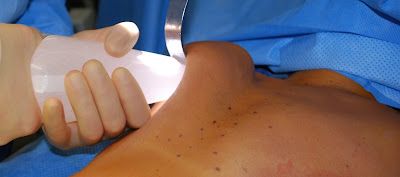
Patients often ask me what they will look like post-operatively from capsular contracure surgery in terms of bruising. I often tell patents that swelling is normal and can be expected for quite some time following capsular contracture and synmastia surgery. The photo above shows and early (5 day) post-operativel result. I tell patients that early post-operatively the implants and breasts take on a globular shape which improves in almost regular intervals at one month, two months, four months, six months, and then finally at one-year.
Capsular contracture surgery is commonly performed either because the capsules are causing a significant amount of pain to the patient or the capsules are starting to distort the breast shape or size.
Typically capsular contracture surgery tends to restore a normal contour to the breast. Patients often ask me what they will look like after surgery in terms of bruising or swelling.
I often tell patients that during capsular contracture surgery, they may require drains post-operatively to removed fluid from the breast pockets. The drains typically exit just lateral to the breast. Drains can be left in place from one to 5 days post-operatively. The patient in the photo above is an early (5 days) post-operative result.
www.drbriandickinson.com
Monday, April 4, 2011
The Neo-Supracapsular Pocket for Revision Aesthetic Breast Surgery
Having great interest in Breast Reconstruction, Aesthetic Breast, and Revision Breast surgery has afforded me ample opportunity to study the manipulation of the infra-mammary fold and its relation to the perception of breast symmetry.
Two determinants of breast symmetry in photographs or when the patient looks in the mirror is the position of the nipple areola complex (NAC) and the relative distance/inter-relationship between the distance of the NAC to the infra-mammary fold. I have found that the creation of the neo-supracapsular pocket allow the operating surgeon great opportunity to change fold position while maintaining a natural breast contour.
Lifting the infra-mammary fold can be quite challenging for the surgeon and frustrating for the patient if not positioned correctly. If the folds are mal-positioned, then the bra does not contact the base of each breast at the same location which is often frustrating for the patient. Correction of the fold position alone can often change not only the position of the NAC, but also the position of the NAC in relation to the center of the implant which can make the asymmetry worse. Therefore to optimize breast symmetry the surgeon will have to calculate the distance from the fold to the NAC and try to adjust each breast to reach a common length. At the same time, similar or dissimilar implants must be selected to optimize volume symmetry as well as centralize the NAC on the implant base.
I have found great utility in the use of the "neo-supracapsular" pocket, not previously described for the correction of this deformity and in breast cancer reconstruction. The neo-supracapsular pocket allows the surgeon the opportunity to correctly position the fold, yet also have control of the contour of the breast without creating dimpling, blunting the fold, or restricting the NAC to fold distance.
http://www.drbriandickinson.com/
Tuesday, November 16, 2010
Strattice for Revision Aesthetic Breast Surgery in Elite Athletes
Capsular contracture occurs when the lining around a breast implant contracts aggressively. When capsules are not removed in their entirety on the anterior surface of the breast, then the breast can not expand or splay out over the new implant in its entirety.
Occasionally, in the re-operative or revision breast surgery patient implants can become infected and need to be removed for several months while the infection completely resolves.
In these patients, I find that optimal results are achieved when the capsule remnants are removed completely prior to the placement of new implants. Strattice can then be used to line the breast implant pocket. When Strattice is used to line the breast implant pocket, the inframammary fold can be set, malposition can be adjusted, and in the thin patient rippling can be improved by the addition of another layer.
Friday, March 5, 2010
Strattice for Revision Aesthetic Breast Augmentation

We are starting to see many patients come from out of state to have their revision augmentation procedures or capsulectomy surgeries performed at the Roxbury Clinic & Surgery Center. I have been using the Strattice in the manner as taught to me by Neal Handel, M.D. When working through small incisions, I have found the use of appropriately and carefully placed marionette sutures to align the Strattice in correct position while the remaining sutures are performed through the limited incision.
I have found Strattice to be very helpful in the revision breast augmentation patient who has rippling, implant palpability, synmastia, bottoming out, and fold asymmetry. I have also found Strattice to be helpful as a barrier between the nipple areola complex incision and the capsule of the breast implant.
I remember repeatedly, the lessons on tendon healing by one of my great mentors, Malcolm Lesavoy, M.D. He would always describe the "one wound/one scar" theory for tendon healing. I find that the same theory can apply to breast implant capsules.
Frequently, I see patients who present for capsular contracture surgery who have a thickened scar beneath their periareolar incision with a "scar rind" that is aggressively fixed to their underlying capsule. It is my belief that the interposed Strattice may prevent the "scar rind" that I frequently see beneath the periareolar incision that is firmly fixed to the capsule. I hope this has great implications for reducing capsular contracture.
http://www.drbriandickinson.com/
Monday, February 22, 2010
No Touch Teqhnique Breast Implant Delivery

I have been using the Keller Funnel routinely for my periareolar and transaxillary breast augmentation cases. The Keller Funnel allows me to deliver larger implants through a smaller incision without traumatizing the breast implant, the skin, or having the breast implant come into contact with the skin.
I believe strongly that this "no touch technique delivery system" can help reduce the incidence of capsular contracture. It is of paramount importance to me that my patients receive great results and that I try to do everything possible to minimize complications.
Brian P. Dickinson, M.D.
Tuesday, February 16, 2010
Revision Augmentation Mastopexy Surgery

www.drbriandickinson.com
I have found an increasing number of women who present to my office in consultation who had saline breast implants placed ten years ago and who are now requesting removal and replacement of their mammary implants for highly cohesive silicone gel mammary prosthesis.
Often these women underwent reduction mammoplasty with an implant to maintain upper pole fullness, but now want to change to an implant with a slightly higher profile to deliver more breast projection.
We are seeing more women present from out of state who come to
These operations are challenging to preserve the blood supply to the nipple areola complex as previous operations contribute to scarring and necessitate experience with these cases to deliver consistent results.
Bilateral capsulectomies, implant exchange, and mastopexy are commonly performed operations in
http://www.drbriandickinson.com/
Subscribe to:
Posts (Atom)